Complete Unicode Small Text Character Map: A–Z, Numbers and Missing Letters
Copy and compare Unicode small-cap, superscript, and subscript characters, see which A–Z letters are missing, and learn when HTML or CSS is the safer choice.
Unicode small text looks simple at first. You type normal letters, convert them, and suddenly your words look tiny.
However, there is more going on than a smaller font.
A Unicode small text character map combines several types of real Unicode characters. These include small capitals, modifier letters, superscript letters, and subscript characters.
Unicode does not provide one official miniature A–Z alphabet. Instead, these characters come from different parts of the Unicode Standard and serve different linguistic, phonetic, mathematical, or compatibility purposes.
This guide uses Unicode 17.0, the latest final Unicode release as of August 2026. It maps the available A–Z characters, numbers, code points, and genuine gaps without inventing replacements.
What Is Unicode Small Text?
Unicode is a text-encoding standard. It assigns a unique code point to each encoded character.
A font controls how that character looks.
Therefore, converting a into ᵃ does not simply reduce its font size. The character ᵃ has its own Unicode identity: U+1D43 MODIFIER LETTER SMALL A.
That distinction explains why Unicode small text can often survive copy and paste. You are copying actual characters rather than transferring a visual CSS effect.
Still, the phrase “small text” is informal. Unicode does not define a character category with that exact name.
Many tiny-looking letters exist because linguists and phonetic transcription systems need them. Unicode 17.0 explains, for example, that modifier letters may take superscript or subscript forms and that small-cap-shaped modifier letters have technical phonetic uses.
So, the tiny alphabet people use online is really a carefully assembled character collection. Think of it as an alphabet built by borrowing tools from several well-organized drawers.
Unicode Small Caps Character Map: A–Z
Small capitals resemble uppercase letters while usually sitting closer to lowercase height.
Unicode contains dedicated small-cap forms for most basic Latin letters. However, they do not live in one continuous A–Z range.
| Normal | Small Cap | Unicode Code Point |
|---|---|---|
| A | ᴀ | U+1D00 |
| B | ʙ | U+0299 |
| C | ᴄ | U+1D04 |
| D | ᴅ | U+1D05 |
| E | ᴇ | U+1D07 |
| F | ꜰ | U+A730 |
| G | ɢ | U+0262 |
| H | ʜ | U+029C |
| I | ɪ | U+026A |
| J | ᴊ | U+1D0A |
| K | ᴋ | U+1D0B |
| L | ʟ | U+029F |
| M | ᴍ | U+1D0D |
| N | ɴ | U+0274 |
| O | ᴏ | U+1D0F |
| P | ᴘ | U+1D18 |
| Q | ꞯ | U+A7AF |
| R | ʀ | U+0280 |
| S | ꜱ | U+A731 |
| T | ᴛ | U+1D1B |
| U | ᴜ | U+1D1C |
| V | ᴠ | U+1D20 |
| W | ᴡ | U+1D21 |
| X | — | No dedicated small-cap X |
| Y | ʏ | U+028F |
| Z | ᴢ | U+1D22 |
Is Small-Cap X Missing From Unicode?
Yes. Unicode 17.0 does not contain a dedicated character named LATIN LETTER SMALL CAPITAL X.
For that reason, some small text generators use ordinary lowercase x as a visual substitute.
That workaround may look acceptable in certain fonts. However, x remains U+0078 LATIN SMALL LETTER X. It does not become a true small-cap character simply because it resembles one.
A trustworthy character map should show that distinction instead of quietly replacing the missing character.
Does Unicode Have a Small-Cap Q?
Yes.
The character ꞯ, code point U+A7AF, has the official Unicode name LATIN LETTER SMALL CAPITAL Q.
This matters because many older Unicode small caps charts still mark Q as unavailable. Those charts are now outdated.
Unicode documents U+A7AF as a letter used in Japanese phonemic transcription. Therefore, it is a real encoded character, not a decorative imitation.
Unicode Superscript Small Text A–Z
The superscript-style alphabet is more complete.
Again, Unicode does not store these characters as one decorative alphabet. Instead, the following map combines modifier and superscript Latin letters from several blocks.
| Normal | Superscript | Unicode Code Point |
|---|---|---|
| a | ᵃ | U+1D43 |
| b | ᵇ | U+1D47 |
| c | ᶜ | U+1D9C |
| d | ᵈ | U+1D48 |
| e | ᵉ | U+1D49 |
| f | ᶠ | U+1DA0 |
| g | ᵍ | U+1D4D |
| h | ʰ | U+02B0 |
| i | ⁱ | U+2071 |
| j | ʲ | U+02B2 |
| k | ᵏ | U+1D4F |
| l | ˡ | U+02E1 |
| m | ᵐ | U+1D50 |
| n | ⁿ | U+207F |
| o | ᵒ | U+1D52 |
| p | ᵖ | U+1D56 |
| q | 𐞥 | U+107A5 |
| r | ʳ | U+02B3 |
| s | ˢ | U+02E2 |
| t | ᵗ | U+1D57 |
| u | ᵘ | U+1D58 |
| v | ᵛ | U+1D5B |
| w | ʷ | U+02B7 |
| x | ˣ | U+02E3 |
| y | ʸ | U+02B8 |
| z | ᶻ | U+1DBB |
The unusual character here is superscript-style q.
𐞥 is U+107A5 MODIFIER LETTER SMALL Q. Its Unicode compatibility mapping points to ordinary lowercase q.
Consequently, modern maps can create an A–Z superscript-style sequence using genuine Unicode characters.
However, font support for 𐞥 may be weaker than support for older characters such as ᵃ, ᵇ, or ʰ.
Unicode Small Numbers: 0–9
Unicode provides complete superscript and subscript digit sets.
The superscript sequence is:
⁰ ¹ ² ³ ⁴ ⁵ ⁶ ⁷ ⁸ ⁹
The subscript sequence is:
₀ ₁ ₂ ₃ ₄ ₅ ₆ ₇ ₈ ₉
| Number | Superscript | Code Point | Subscript | Code Point |
|---|---|---|---|---|
| 0 | ⁰ | U+2070 | ₀ | U+2080 |
| 1 | ¹ | U+00B9 | ₁ | U+2081 |
| 2 | ² | U+00B2 | ₂ | U+2082 |
| 3 | ³ | U+00B3 | ₃ | U+2083 |
| 4 | ⁴ | U+2074 | ₄ | U+2084 |
| 5 | ⁵ | U+2075 | ₅ | U+2085 |
| 6 | ⁶ | U+2076 | ₆ | U+2086 |
| 7 | ⁷ | U+2077 | ₇ | U+2087 |
| 8 | ⁸ | U+2078 | ₈ | U+2088 |
| 9 | ⁹ | U+2079 | ₉ | U+2089 |
You may notice that superscript 1, 2, and 3 have very different code points.
That is not a mistake.
¹, ², and ³ belong to the older Latin-1 Supplement range. Most remaining superscript digits appear in the later Superscripts and Subscripts block.
Unicode history is tidy in principle. Its cupboards, however, occasionally contain dishes from different sets.
Are Unicode Subscript Letters Complete?
No. Unlike the digits, Unicode does not contain a complete Latin A–Z subscript alphabet.
The Superscripts and Subscripts block contains characters such as:
ₐ ₑ ₒ ₓ ₕ ₖ ₗ ₘ ₙ ₚ ₛ ₜ
Other modifier blocks add several useful subscript-style letters. Still, you cannot build a straightforward, dedicated A–Z subscript alphabet using one matching Unicode character for every basic Latin letter.
Therefore, websites should avoid claiming that a complete Unicode subscript alphabet exists.
Some generators fill the missing positions with similar-looking symbols. That may produce attractive text, but visual similarity does not prove character equivalence.
Why Do Small Characters Come From Different Unicode Blocks?
Unicode encodes characters according to documented usage and character identity. It does not create every possible typographic variation of every letter.
As a result, small-cap and modifier letters appear across blocks such as IPA Extensions, Spacing Modifier Letters, Phonetic Extensions, Phonetic Extensions Supplement, Latin Extended-D, and Latin Extended-F.
Many support phonetic transcription or specialized orthographies.
This history explains why the character map looks inconsistent. Unicode designers were solving real language and text-processing requirements, not building a social-media font generator.
For the same reason, you should not replace missing Latin characters with lookalikes from Greek or Cyrillic scripts without clearly labeling them.
Two symbols may look almost identical while carrying completely different Unicode identities.
How Do Unicode Code Points Work?
Every encoded Unicode character has a code point.
For example:
ᴀ = U+1D00
⁰ = U+2070
ꞯ = U+A7AF
The U+ prefix identifies a Unicode code point. The numbers and letters after it represent a hexadecimal value.
Code points matter because appearance alone can mislead you. Different characters may look similar in one font yet behave differently during search, normalization, text processing, or accessibility workflows.
Therefore, a reliable Unicode character map should show both the visible character and its code point.
Can You Copy and Paste Unicode Small Text?
Yes. Most of these characters are ordinary encoded text, so you can copy and paste them between applications that support them.
However, successful display depends on fonts and software.
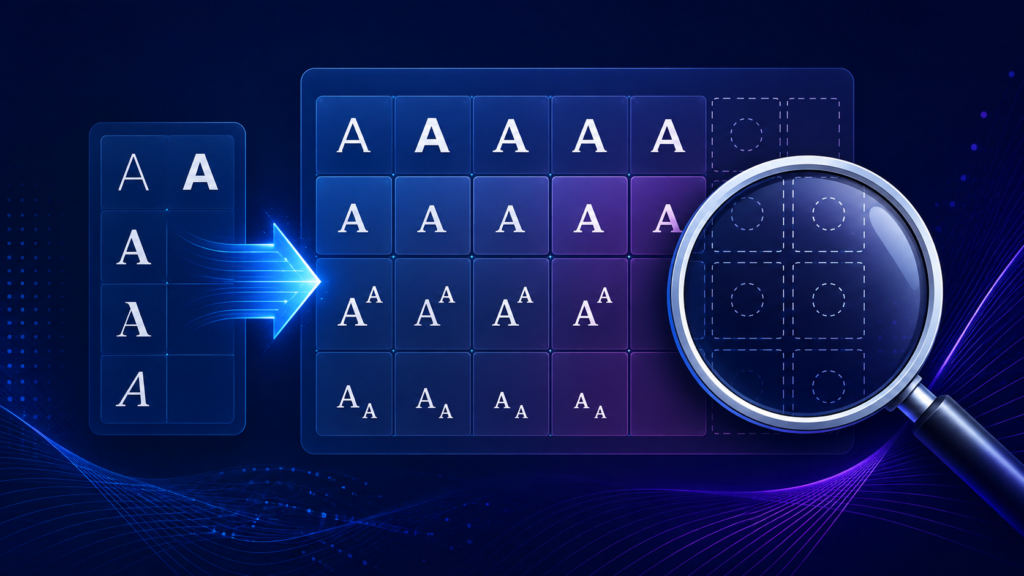
A valid character may appear as an empty square or replacement glyph when a device lacks a font containing that character. People often call the square a “tofu” character.
Newer and uncommon Unicode characters have a greater chance of hitting this problem.
So, always test important text on several browsers, devices, and fonts before relying on unusual characters in a production interface.
Should You Use Unicode Small Text for SEO Content?
Use it carefully.
For ordinary headings, paragraphs, menus, buttons, and important page content, standard Latin letters usually make more sense. If you only want text to appear visually smaller, use CSS.
That approach keeps the underlying characters ordinary while presentation remains under your control.
For HTML superscripts and subscripts, semantic elements such as <sup> and <sub> can also be better when the relationship itself matters.
For example, mathematical exponents, footnote markers, and chemical notation often benefit from proper markup rather than decorative character conversion.
Unicode small text still has useful applications. It works for genuine phonetic characters, short annotations, character-reference tools, demonstrations, and controlled decorative text.
The important rule is simple: use a Unicode character because you need that character, not merely because it happens to look tiny.
Frequently Asked Questions About Unicode Small Text
Is Unicode small text a font?
No. Unicode small text generally uses separate encoded characters. A font only determines how those characters appear.
Is there a complete Unicode small caps alphabet?
Almost, but not quite. Unicode 17.0 provides suitable small-cap Latin characters for most A–Z positions. A dedicated LATIN LETTER SMALL CAPITAL X is still missing.
Is superscript q available in Unicode?
Yes. 𐞥, U+107A5 MODIFIER LETTER SMALL Q, provides a genuine superscript-style q.
Are Unicode superscript numbers complete?
Yes. Unicode includes superscript digits from 0 through 9. It also contains a complete 0–9 subscript digit set.
Why does some small text show as a square?
Usually, the active font lacks a glyph for that Unicode character. The character itself can still be valid.
Final Word
A reliable Unicode small text guide should separate genuine characters from visual substitutes.
Unicode 17.0 provides most of the Latin small-cap alphabet, but a dedicated small-cap X remains missing. In contrast, small-cap Q exists as ꞯ at U+A7AF.
The superscript-style A–Z map can also include a genuine q through 𐞥, U+107A5. Meanwhile, superscript and subscript numbers both offer complete 0–9 sets.
Subscript letters remain incomplete, so any tool claiming a perfect subscript A–Z alphabet should explain which characters are substitutes.
Ultimately, accuracy matters more than making every row look beautifully complete. Unicode already contains plenty of fascinating characters. There is no need to give the missing ones fake moustaches and pretend they were there all along.
Source basis: The Unicode Standard, Version 17.0; Unicode official code charts and NamesList data for Basic Latin, IPA Extensions, Spacing Modifier Letters, Phonetic Extensions, Phonetic Extensions Supplement, Superscripts and Subscripts, Latin Extended-D, and Latin Extended-F.

Related Articles