Complete Superscript Numbers and Symbols Copy-and-Paste Table
Copy superscript numbers and common symbols, see their Unicode code points, and learn when to use characters, HTML, or MathML.
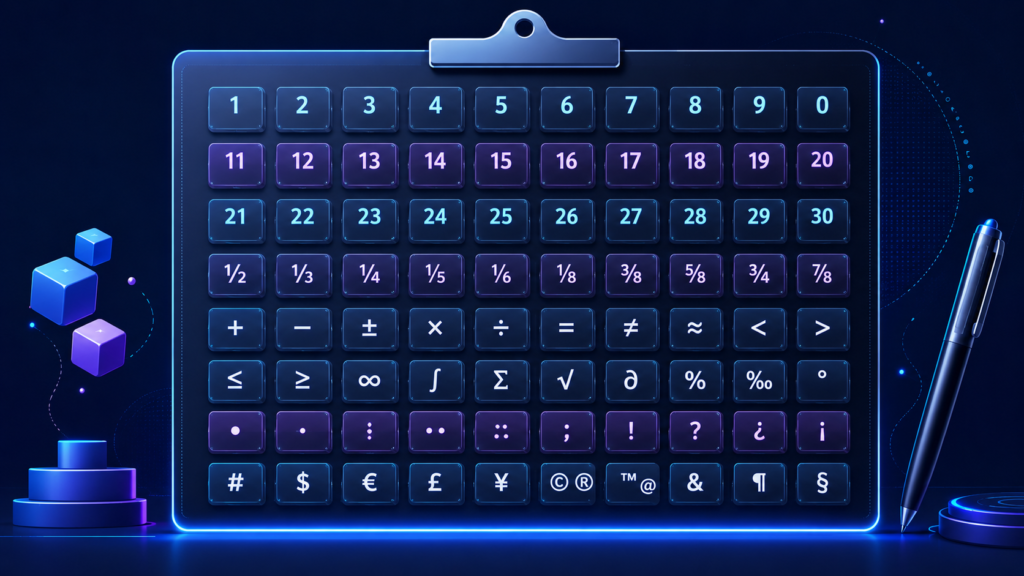
Need a superscript number for an exponent, measurement, footnote, formula, username, or plain-text message? You can copy the character you need directly from this page.
This superscript numbers and symbols copy-and-paste table includes every Unicode superscript digit from 0 to 9. It also covers the dedicated superscript plus, minus, equals, and parentheses characters.
Quick copy — numbers: ⁰ ¹ ² ³ ⁴ ⁵ ⁶ ⁷ ⁸ ⁹
Quick copy — symbols: ⁺ ⁻ ⁼ ⁽ ⁾
Related letters: ⁱ ⁿ
These are real Unicode characters. In other words, a character such as ² has its own Unicode code point. It is not simply a normal number 2 displayed with a smaller font.
That makes Unicode superscripts useful when ordinary text formatting is unavailable. However, structured markup remains the better choice for complex mathematics.
Superscript Numbers Copy-and-Paste Table
Use the following table to copy any superscript digit.
| Normal Number | Superscript | Unicode Code Point | Unicode Name |
|---|---|---|---|
| 0 | ⁰ | U+2070 | Superscript Zero |
| 1 | ¹ | U+00B9 | Superscript One |
| 2 | ² | U+00B2 | Superscript Two |
| 3 | ³ | U+00B3 | Superscript Three |
| 4 | ⁴ | U+2074 | Superscript Four |
| 5 | ⁵ | U+2075 | Superscript Five |
| 6 | ⁶ | U+2076 | Superscript Six |
| 7 | ⁷ | U+2077 | Superscript Seven |
| 8 | ⁸ | U+2078 | Superscript Eight |
| 9 | ⁹ | U+2079 | Superscript Nine |
Unicode does not place all ten superscript digits in one continuous sequence.
The characters ¹, ², and ³ belong to the Latin-1 Supplement block. By contrast, ⁰ and ⁴ through ⁹ appear in the Superscripts and Subscripts block.
Unicode explains that the first three remain in Latin-1 Supplement for compatibility with ISO/IEC 8859-1. Therefore, U+2072 and U+2073 remain reserved rather than duplicating ² and ³.
The arrangement may look slightly untidy, but Unicode values compatibility more than a beautifully organized filing cabinet.
Superscript Symbols Copy-and-Paste Table
Unicode also defines several dedicated superscript mathematical symbols.
| Standard Symbol | Superscript | Unicode Code Point | Unicode Name |
|---|---|---|---|
| + | ⁺ | U+207A | Superscript Plus Sign |
| − | ⁻ | U+207B | Superscript Minus |
| = | ⁼ | U+207C | Superscript Equals Sign |
| ( | ⁽ | U+207D | Superscript Left Parenthesis |
| ) | ⁾ | U+207E | Superscript Right Parenthesis |
Unicode assigns these characters consecutively from U+207A to U+207E in the Superscripts and Subscripts block.
As a result, you can create short plain-text expressions such as:
x⁻¹
10⁺³
a⁽²⁾
xⁿ⁺¹
However, this block does not contain superscript versions of every mathematical operator. For example, it does not provide matching superscript multiplication and division signs.
Avoid replacing missing operators with unrelated characters that only look similar. Visual similarity does not make two Unicode characters equivalent.
Related Unicode Superscript Letters
The same Unicode block contains two useful superscript letters.
| Normal Letter | Superscript | Unicode Code Point | Unicode Name |
|---|---|---|---|
| i | ⁱ | U+2071 | Superscript Latin Small Letter I |
| n | ⁿ | U+207F | Superscript Latin Small Letter N |
Unicode also includes many raised modifier letters in other blocks.
For example, the Spacing Modifier Letters, Phonetic Extensions, and Phonetic Extensions Supplement blocks contain characters that may look like superscript letters. However, Unicode generally identifies those characters as modifier letters because they often serve phonetic purposes.
Therefore, a list of every character that happens to look raised would mix several different Unicode functions.
For a practical superscript numbers and symbols reference, the digits and mathematical characters above provide the most relevant core set.
What Are Unicode Superscript Numbers?
A superscript sits above the normal text baseline and usually appears smaller than nearby text.
You commonly see superscripts in exponents, measurements, references, scientific notation, and mathematical expressions.
For example:
x² means x raised to the power of two.
10⁶ represents ten to the sixth power.
m³ commonly represents cubic metres.
With Unicode superscripts, the raised digit exists as an encoded character. For instance, the character ² uses the code point U+00B2.
That differs from formatting an ordinary 2 so that a browser or word processor displays it higher.
Unicode’s mathematics guidance describes superscript and subscript characters as useful for some mathematical text. However, it also recommends structured markup instead of these compatibility characters for MathML or TeX-style mathematical documents.
Therefore, Unicode superscripts work best for compact plain text rather than complex mathematical notation.
How to Copy and Paste Superscript Numbers
Copying superscript characters takes only a few seconds.
- Select the superscript number or symbol you need.
- Copy it with your device’s normal copy command.
- Paste it into the destination.
- Check that the destination displays the character correctly.
For example, combine ², ⁰, ², and ⁶ to create:
²⁰²⁶
Most modern systems support these Unicode characters. Still, appearance can vary because fonts control how each glyph looks.
In addition, some websites, databases, apps, or input fields may normalize or restrict certain Unicode characters. Therefore, always check important text after pasting it.
Common Uses for Superscript Numbers and Symbols
Unicode superscripts work well when you need compact plain text.
Exponents
You can write simple powers such as:
x²
y³
10⁸
2ⁿ
These characters make short expressions easy to read even when rich-text formatting is unavailable.
Measurements
Superscript numbers often appear in square and cubic units.
Common examples include:
m²
km²
cm³
ft³
The surrounding unit provides the meaning, while the superscript shows the power.
Plain-Text Fields
Unicode characters can also help in messages, database fields, notes, profiles, and other places where HTML formatting does not work.
For example, a field may preserve m² as text even when it cannot interpret HTML tags.
However, Unicode superscripts cannot represent every mathematical structure. They are useful tools, not miniature replacements for an entire equation editor.
Unicode Superscripts vs. HTML <sup>
Website owners have another option: the HTML <sup> element.
For example:
x<sup>2</sup>
A browser normally displays that markup as x with a raised 2.
MDN defines <sup> as the HTML element for inline text that follows superscript typographical conventions. Suitable uses include exponents, ordinal notation, and certain forms of superior lettering.
The key difference lies in the underlying content.
Unicode: x²
Here, ² is its own character.
HTML: x<sup>2</sup>
Here, the underlying character remains an ordinary 2, while HTML describes its superscript role.
For regular webpage content, HTML often offers better flexibility. For plain-text copying, however, Unicode characters can be more convenient.
When Should You Use MathML?
Complex mathematical expressions need more structure than a few raised characters can provide.
MathML includes elements specifically for scripts. For example, <msup> attaches a superscript to a mathematical base, while <msub> and <msubsup> handle subscripts and combined scripts.
The W3C MathML Core specification defines these elements as part of its script and limit system.
Therefore, consider MathML when the mathematical structure itself matters.
A simple x² in plain text may need nothing more. A detailed equation with nested powers, fractions, limits, and subscripts deserves proper mathematical markup.
Do Superscript Characters Work Everywhere?
No character works perfectly in every environment.
Unicode assigns a stable identity and code point to each character. However, fonts decide how the character looks, while software decides how it processes the text.
This becomes especially important with:
- usernames;
- passwords;
- source code;
- database identifiers;
- search fields;
- filenames;
- URLs;
- mathematical data.
Some systems also apply Unicode normalization.
Unicode defines four main normalization forms: NFC, NFD, NFKC, and NFKD. The compatibility forms NFKC and NFKD can remove compatibility distinctions. Unicode’s normalization documentation specifically shows superscript formatting disappearing from a superscript digit under compatibility normalization.
For example, a system that applies NFKC may treat a superscript character such as ⁵ as its ordinary equivalent 5.
Therefore, do not assume that visually different characters will always remain distinct inside technical identifiers.
Frequently Asked Questions
What are all superscript numbers from 0 to 9?
The complete Unicode superscript digit set is:
⁰ ¹ ² ³ ⁴ ⁵ ⁶ ⁷ ⁸ ⁹
You can copy the entire sequence or select a single digit.
Are superscript numbers real Unicode characters?
Yes. Each digit has an assigned Unicode code point.
The characters ¹, ², and ³ appear in Latin-1 Supplement. The remaining digits appear in the Superscripts and Subscripts block.
What superscript mathematical symbols can I copy?
The core mathematical superscript symbols in this Unicode block are:
⁺ ⁻ ⁼ ⁽ ⁾
They represent plus, minus, equals, left parenthesis, and right parenthesis.
Why are ¹, ², and ³ stored separately?
Unicode keeps them in Latin-1 Supplement to maintain compatibility with ISO/IEC 8859-1.
It does not duplicate ² and ³ at U+2072 and U+2073. Those positions remain reserved.
Is superscript text the same as small text?
No.
A superscript usually sits above the baseline. A Unicode superscript such as ⁵ also has a distinct code point.
By contrast, CSS or HTML can visually raise an ordinary character without changing that character into a different Unicode code point.
Should I use Unicode or HTML for superscript on a website?
Use Unicode when you specifically need a portable plain-text character such as ².
Use HTML <sup> when webpage markup should describe a typographical superscript. For complex mathematical expressions, consider MathML instead.
Complete Superscript Numbers and Symbols Set
For quick reference, here is the essential collection again:
Superscript numbers:
⁰ ¹ ² ³ ⁴ ⁵ ⁶ ⁷ ⁸ ⁹
Superscript symbols:
⁺ ⁻ ⁼ ⁽ ⁾
Related superscript letters:
ⁱ ⁿ
These characters come from defined Unicode code points rather than decorative text generators or invented look-alikes.
Use Unicode when plain-text portability matters. Use HTML <sup> when semantic webpage markup fits the job. Finally, use MathML when your mathematics needs richer structure.
That keeps your text accurate, readable, and much less likely to turn a simple superscript into a surprisingly complicated adventure.

Related Articles