Why Some Letters Do Not Convert into Superscript or Subscript
Learn why Unicode superscript and subscript alphabets have gaps, what converters substitute, and which formatting method to use instead.
You enter a word into a converter and expect every letter to become tiny. Most characters change, but one stubborn letter stays normal.
It looks like the converter has failed. However, the real reason often lies in Unicode, not the tool.
Unicode does not provide a complete set of superscript and subscript letters for every alphabet. It includes certain raised and lowered characters for specific linguistic, mathematical, technical, and compatibility purposes.
As a result, a plain-text converter can only use characters that actually exist in Unicode. If Unicode has no suitable equivalent, the converter cannot produce an exact one.
Here is why that happens and what you can use instead.
Superscript and Subscript Letters Are Not Just Smaller Text
First, it helps to separate Unicode characters from text formatting.
Unicode gives characters unique code points so computers can store, process, and exchange text consistently. A font then decides how those characters look on screen.
Superscript formatting works differently. It takes ordinary characters and visually positions them above the normal text baseline. Subscript formatting moves them below it.
That difference matters.
The Unicode Standard explains that it generally does not encode the visual position of ordinary text. Instead, it recommends styling or markup when users need arbitrary text in superscript or subscript form.
Therefore, a Unicode superscript converter usually does not “format” your original letter. It replaces that letter with a different Unicode character that looks raised.
For example:
2 can become ².
n can become ⁿ.
a can become ₐ.
If no matching character exists, however, substitution becomes impossible.
Unicode Does Not Contain a Complete Superscript Alphabet
This limitation is intentional.
The Unicode Consortium directly addresses why Unicode does not contain a full set of superscripts and subscripts. It explains that many existing characters came from legacy standards or serve as modifier letters in specialist transcription systems.
They were not created as a universal miniature alphabet.
For example, phonetic systems such as the International Phonetic Alphabet (IPA) and Uralic Phonetic Alphabet (UPA) use modifier letters for specific linguistic meanings.
Some of those modifier letters look like ordinary superscript Latin characters. However, their raised appearance does not automatically make them generic replacements for normal letters.
The Unicode Standard also notes that many modifier letters have superscript or subscript forms and serve technical phonetic purposes.
So, visual similarity can be misleading.
A tiny raised character may look perfect in your username or social post while carrying a different technical meaning in Unicode.
Why Superscript Numbers Convert More Easily
Numbers usually cause fewer problems because Unicode provides much better coverage for them.
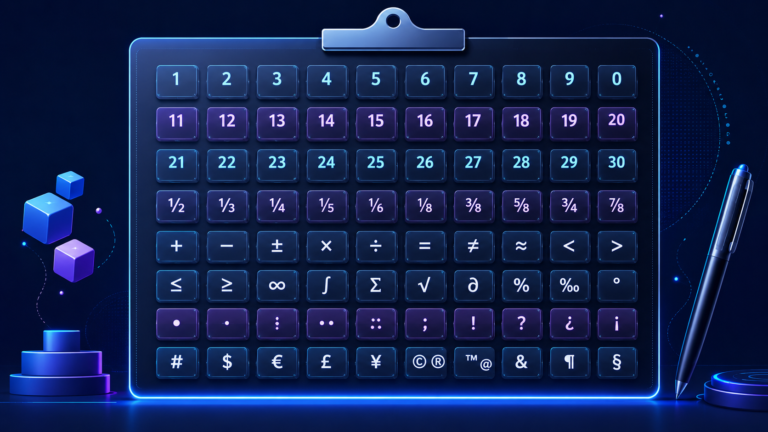
The Superscripts and Subscripts block, which occupies the range U+2070–U+209F, contains superscript digits such as ⁰ and ⁴ through ⁹. It also contains the complete set of subscript digits ₀ through ₉.
The familiar superscript characters ¹, ², and ³ live elsewhere in Unicode because they came from earlier character standards.
Unicode also includes superscript and subscript versions of several mathematical symbols. These include plus, minus, equals, and parentheses.
Therefore, expressions such as x² or chemical text such as H₂O work well in plain Unicode text.
Letters have much less consistent coverage.
Why Some Subscript Letters Work and Others Do Not
Unicode subscript letters provide a good example of this uneven coverage.
The U+2070–U+209F block contains specific lowercase subscript characters, including:
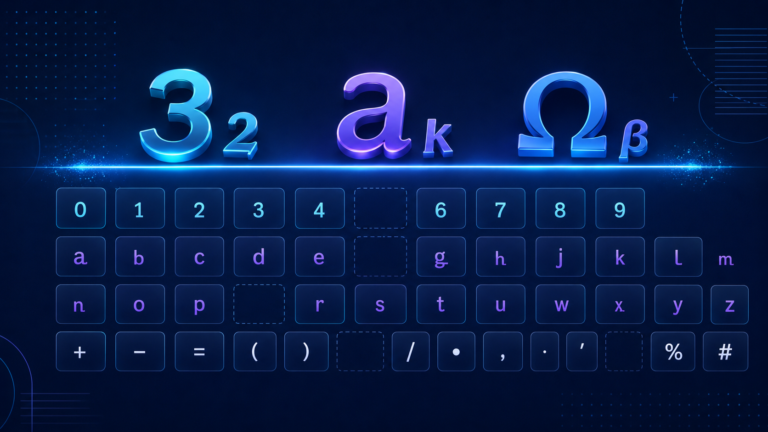
ₐ ₑ ₒ ₓ ₔ ₕ ₖ ₗ ₘ ₙ ₚ ₛ ₜ
However, that group does not represent a complete lowercase Latin alphabet.
Therefore, a subscript converter may successfully change one letter and leave the next one untouched.
That behaviour does not automatically indicate a programming error.
The converter may simply lack a valid Unicode character to use.
Why Different Superscript Converters Give Different Results
Not every superscript or subscript converter follows the same rules.
One tool may use only clearly corresponding Unicode characters. Another may combine characters from several Unicode blocks.
Some converters also use modifier letters, phonetic characters, or other lookalike symbols to fill gaps.
That approach can create a more complete-looking alphabet. However, the replacement character may not carry the same semantic identity as the original letter.
For casual decorative text, that distinction may not matter much.
For technical writing, linguistics, accessibility, data processing, search, or software development, it can matter a great deal.
Therefore, the converter with the most converted characters is not automatically the most technically accurate one.
Sometimes the tool that leaves a character alone makes the safer choice.
Font Support Can Cause Another Problem
Even when Unicode contains a character, your device still needs to display it.
A font does not necessarily contain a visible glyph for every Unicode character.
If the selected font lacks a glyph, the browser or operating system may try another font. If that also fails, you may see an empty square, rectangle, or missing-character symbol.
Unicode documentation commonly refers to the empty-box problem as missing-glyph display behaviour.
Therefore, two separate questions matter:
Does Unicode define the character?
Does the font and rendering system support it?
A different font can solve the second problem. However, a font cannot solve the first.
If Unicode has no appropriate character, installing another font will not create a new Unicode code point.
Think of Unicode as assigning the character an identity. The font merely decides what clothes that character wears.
Changing the clothes does not create the person.
Unicode Normalization Can Also Affect Superscripts
Text processing adds another wrinkle.
Many superscript, subscript, and modifier characters have compatibility decompositions in Unicode.
Unicode defines several normalization forms, including NFC, NFD, NFKC, and NFKD. Compatibility normalization through NFKC or NFKD can convert some specialized characters into more ordinary equivalents.
For example, compatibility normalization may remove the distinction between certain superscript or subscript characters and their ordinary forms.
That does not mean every website automatically changes your text.
However, developers should consider normalization when handling usernames, search indexes, database values, comparison systems, and other machine-processed text.
What looks different to a person may become equivalent after certain normalization operations.
Use HTML for Real Superscript and Subscript on Websites
If you control a website, you usually do not need to hunt for special Unicode letters.
HTML already provides semantic elements for this purpose.
The <sup> element represents superscript, while <sub> represents subscript.
For example:
x<sup>2</sup>
produces a properly marked-up exponent.
Likewise:
H<sub>2</sub>O
marks the 2 as a subscript.
The WHATWG HTML Standard says authors should use <sup> and <sub> for typographical conventions that carry meaning, rather than for decoration alone.
That distinction helps keep web content semantically meaningful.
HTML also lets you superscript normal text without searching for separate Unicode versions of every letter.
Therefore, markup solves the alphabet-coverage problem that plain Unicode converters face.
Use MathML for More Complex Mathematical Notation
HTML <sup> and <sub> work well for many common cases. Complex mathematics may need something more powerful.
That is where MathML helps.
MathML provides <msup> for superscripts and <msub> for subscripts. It also provides <msubsup> when an expression needs both.
For example, <msubsup> attaches a subscript and a superscript to the same base expression.
This structure works better for mathematical meaning than trying to assemble an equation from visually similar Unicode characters.
In short, use the right tool for the job.
Unicode works well for genuine plain-text characters. HTML handles meaningful web typography. MathML handles structured mathematical notation.
Is a Superscript Converter Broken If Some Letters Stay Normal?
Not necessarily.
If the converter changes most characters but skips specific letters, Unicode coverage may explain the gap.
A different converter might still change that letter. However, it may achieve the effect with a modifier character or another lookalike rather than a direct equivalent.
Therefore, compare the underlying characters, not only their appearance.
Why Can 2 Become ² but Every Letter Cannot Convert?
Unicode contains widely supported superscript and subscript digits because of historical, mathematical, and compatibility needs.
Letters followed a different path.
Unicode encoded many raised or lowered letters for specific phonetic or technical purposes. It did not create a generic superscript and subscript copy of every alphabet.
That is why numbers often convert more consistently than letters.
Can a Special Font Create Missing Superscript Letters?
No, not when the Unicode character itself does not exist.
A font can provide a glyph for an existing character. It can also visually style ordinary letters in a raised position.
However, it cannot invent a standardized Unicode code point.
If you only need a visual superscript effect, CSS, HTML, or another rich-text system can style ordinary text instead.
Are Unicode Superscript and Subscript Letters Good for SEO?
Use them when they genuinely serve the content, not as an SEO trick.
Google Search Central recommends helpful, reliable, people-first content. Google also advises publishers to use the words people search for naturally in prominent locations such as titles and headings.
The same foundation now applies to Google’s generative AI search features.
Google states that normal SEO best practices remain relevant for AI Overviews and AI Mode. It does not require special AI-specific markup simply to appear in those experiences.
Therefore, clear explanations, accurate terminology, useful examples, meaningful markup, and trustworthy sourcing matter far more than decorative Unicode characters.
Final Takeaway
Some letters do not convert into superscript or subscript because Unicode does not contain a complete generic superscript or subscript alphabet.
Many available characters exist for legacy compatibility, phonetic transcription, mathematics, or other specialized uses. A converter can only work with those available characters unless it substitutes a lookalike.
Font support can create additional display problems. Unicode normalization can also affect certain characters during text processing.
For plain-text environments, Unicode superscript and subscript characters can still be useful. Just expect gaps.
For websites, use semantic HTML <sup> and <sub> elements when appropriate. For complex equations, use MathML.
Sometimes that one letter refusing to shrink is not being difficult after all. It is simply following the standard.

Related Articles