Complete Subscript Numbers, Letters and Symbols Table
Copy Unicode subscript numbers, supported letters, and symbols, identify missing characters, and choose accessible markup when needed.
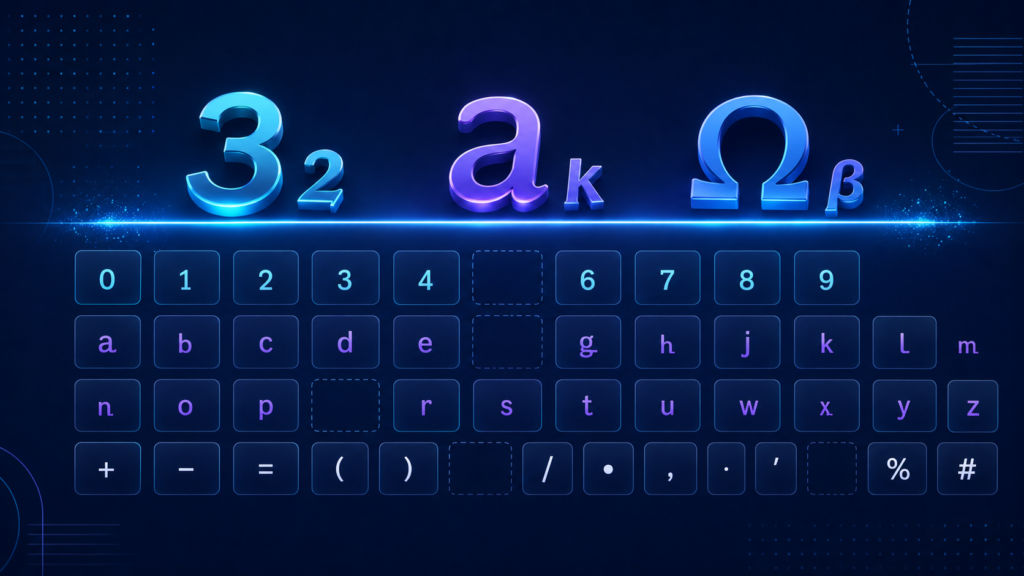
Looking for subscript numbers, letters and symbols that you can copy and paste? This guide brings the supported Unicode characters together in one place, along with their Unicode code points and HTML character references.
Subscripts appear slightly below the normal text baseline. You commonly see them in chemistry, mathematics, phonetics, scientific notation, and technical writing. For example, the ₂ in H₂O shows that one water molecule contains two hydrogen atoms.
However, there is an important detail. Unicode includes all ten subscript numbers and several useful symbols, but it does not provide a complete subscript alphabet from a to z.
That matters because many online “subscript generators” fill the missing letters with characters that only look similar. This guide sticks to genuine Unicode characters and established web standards instead.
The current Unicode Standard, Version 17.0, places the main collection of these characters in the Superscripts and Subscripts block from U+2070 to U+209F. Additional subscript letters appear in the Phonetic Extensions and Latin Extended-C blocks.
Subscript Numbers 0–9
Unicode provides a complete set of subscript digits from 0 to 9. Their code points run consecutively from U+2080 through U+2089.
| Normal Number | Subscript | Unicode | HTML Decimal | HTML Hex |
|---|---|---|---|---|
| 0 | ₀ | U+2080 | ₀ | ₀ |
| 1 | ₁ | U+2081 | ₁ | ₁ |
| 2 | ₂ | U+2082 | ₂ | ₂ |
| 3 | ₃ | U+2083 | ₃ | ₃ |
| 4 | ₄ | U+2084 | ₄ | ₄ |
| 5 | ₅ | U+2085 | ₅ | ₅ |
| 6 | ₆ | U+2086 | ₆ | ₆ |
| 7 | ₇ | U+2087 | ₇ | ₇ |
| 8 | ₈ | U+2088 | ₈ | ₈ |
| 9 | ₉ | U+2089 | ₉ | ₉ |
Copy and paste: ₀ ₁ ₂ ₃ ₄ ₅ ₆ ₇ ₈ ₉
You can combine these characters just like ordinary digits. For example, you can write x₁, x₂, ₁₂, ₂₅, or ₂₀₂₆.
Because these are Unicode characters, they remain part of the text itself. They are not images or CSS-generated decorations.
Subscript Symbols and Mathematical Operators
Unicode also includes five common subscript symbols in the same block. These cover plus, minus, equals, and both parentheses.
| Normal Symbol | Subscript | Unicode | HTML Decimal | HTML Hex |
|---|---|---|---|---|
| + | ₊ | U+208A | ₊ | ₊ |
| − | ₋ | U+208B | ₋ | ₋ |
| = | ₌ | U+208C | ₌ | ₌ |
| ( | ₍ | U+208D | ₍ | ₍ |
| ) | ₎ | U+208E | ₎ | ₎ |
Copy and paste: ₊ ₋ ₌ ₍ ₎
Unicode does not provide a matching subscript version of every punctuation mark or currency symbol. For example, there is no dedicated Unicode subscript dollar sign or percent sign in this block.
Therefore, if you need arbitrary text below the baseline on a webpage, HTML markup will usually give you better results than hunting for visual substitutes.
Subscript Letters A–Z: Which Letters Actually Exist?
This is where subscript characters become slightly less tidy.
Unicode does not contain a complete set of dedicated lowercase subscript letters from a through z. Instead, the supported Latin characters appear across several Unicode blocks.
The main Superscripts and Subscripts block contains a, e, o, x, schwa, h, k, l, m, n, p, s, and t. The Phonetic Extensions block adds i, r, u, and v. Latin Extended-C contains the subscript letter j.
| Normal Letter | Subscript | Unicode | Normal Letter | Subscript | Unicode |
|---|---|---|---|---|---|
| a | ₐ | U+2090 | j | ⱼ | U+2C7C |
| e | ₑ | U+2091 | k | ₖ | U+2096 |
| h | ₕ | U+2095 | l | ₗ | U+2097 |
| i | ᵢ | U+1D62 | m | ₘ | U+2098 |
| n | ₙ | U+2099 | o | ₒ | U+2092 |
| p | ₚ | U+209A | r | ᵣ | U+1D63 |
| s | ₛ | U+209B | t | ₜ | U+209C |
| u | ᵤ | U+1D64 | v | ᵥ | U+1D65 |
| x | ₓ | U+2093 | ə | ₔ | U+2094 |
Copy and paste: ₐ ₑ ₕ ᵢ ⱼ ₖ ₗ ₘ ₙ ₒ ₚ ᵣ ₛ ₜ ᵤ ᵥ ₓ ₔ
Which English Letters Do Not Have Unicode Subscripts?
Nine basic lowercase Latin letters have no dedicated Unicode subscript equivalent:
b, c, d, f, g, q, w, y, z
This limitation explains why some online converters produce unusual results for a “complete” subscript alphabet.
A generator may borrow a small capital, modifier character, phonetic symbol, or letter from another script because it looks similar. Visually, the trick may work. Technically, however, the character remains something else.
In other words, putting a tiny hat on a character does not magically change its passport.
For ordinary web content, use the HTML <sub> element when Unicode lacks the character you need.
Greek Subscript Letters
Unicode includes five Greek subscript modifier letters in the Phonetic Extensions block. These are beta, gamma, rho, phi, and chi. Their code points run from U+1D66 through U+1D6A.
| Greek Letter | Subscript | Unicode | HTML Decimal |
|---|---|---|---|
| β | ᵦ | U+1D66 | ᵦ |
| γ | ᵧ | U+1D67 | ᵧ |
| ρ | ᵨ | U+1D68 | ᵨ |
| φ | ᵩ | U+1D69 | ᵩ |
| χ | ᵪ | U+1D6A | ᵪ |
Copy and paste: ᵦ ᵧ ᵨ ᵩ ᵪ
Unicode describes these characters as Greek subscript modifier letters. They have specific phonetic uses, so they should not be treated as a complete Greek subscript alphabet.
Unicode Subscripts vs HTML <sub>
Unicode characters and HTML subscripts can look similar, but they work differently.
A Unicode subscript is an individual encoded character. For example, ₂ has its own code point: U+2082.
HTML takes another approach. The <sub> element tells the browser that ordinary text should appear as a meaningful subscript.
For example:
H<sub>2</sub>O
A browser displays that markup as H₂O.
The WHATWG HTML Standard defines <sub> specifically for typographical conventions where the lowered position carries meaning. It also gives mathematical variables as a valid example.
Therefore, HTML gives you more freedom. You can write:
x<sub>abc</sub>
even though Unicode does not contain dedicated subscript forms for b and c.
When Should You Use Unicode Subscript Characters?
Unicode characters work well when you need genuine plain text.
For example, they can be useful in notes, messages, labels, plain-text documents, database fields, or other environments where HTML formatting is unavailable.
They also make copying simple when the exact subscript character already exists.
When Should You Use the HTML <sub> Element?
Use <sub> when you control the webpage and the lowered text carries semantic meaning.
This method works particularly well for chemical formulas, mathematical variables, and expressions that contain letters without Unicode subscript equivalents.
The HTML Standard also recommends more specialized mathematical markup, including MathML, when a page requires complex mathematical notation.
How HTML Character References Work
You do not always need to type a Unicode character directly.
HTML can represent Unicode characters through numeric character references. You can use either a decimal value or a hexadecimal value.
For example, all three forms below refer to the subscript digit two:
Character: ₂
Decimal: ₂
Hexadecimal: ₂
That makes character references useful in source code, templates, content-management systems, and situations where direct character entry becomes inconvenient.
Why Do Some Subscript Characters Appear as Boxes?
Sometimes a valid subscript character appears as an empty square, rectangle, or replacement symbol.
Usually, the character itself is not broken. Instead, the selected font may not contain a glyph for that Unicode code point.
Unicode notes that fonts need appropriate character coverage to display encoded characters correctly. The Phonetic Extensions documentation also explains that these special forms serve particular phonetic systems.
Therefore, using a modern browser and a font with broad Unicode support can solve many display problems.
Common Uses of Subscript Numbers, Letters and Symbols
Subscripts help readers understand relationships that ordinary baseline text cannot express as clearly.
In chemistry, formulas such as H₂O and CO₂ use subscript numbers to show the number of atoms in a molecule.
In mathematics, writers use subscripts to distinguish related variables. Examples include x₁, x₂, aₙ, and similar indexed values.
Phonetic systems also use selected subscript letters. In fact, Unicode specifically explains that some small capital, superscript, and subscript forms in Phonetic Extensions carry semantic importance in phonetic representation.
So, subscripts are not simply miniature characters placed there for decoration. Their position can change the meaning of the text.
Complete Copy-and-Paste Subscript Table
Subscript numbers: ₀ ₁ ₂ ₃ ₄ ₅ ₆ ₇ ₈ ₉
Subscript symbols: ₊ ₋ ₌ ₍ ₎
Latin and phonetic subscript letters: ₐ ₑ ₕ ᵢ ⱼ ₖ ₗ ₘ ₙ ₒ ₚ ᵣ ₛ ₜ ᵤ ᵥ ₓ ₔ
Greek subscript letters: ᵦ ᵧ ᵨ ᵩ ᵪ
These are genuine Unicode characters rather than invented substitutes.
Frequently Asked Questions
Is There a Complete Unicode Subscript Alphabet From A to Z?
No. Unicode provides many lowercase Latin subscript letters, but it does not encode every letter from a to z.
The missing basic lowercase Latin letters are b, c, d, f, g, q, w, y, and z. Use HTML <sub> when you need those letters as proper subscripts on a webpage.
Can I Copy and Paste Subscript Numbers?
Yes. Unicode provides all ten subscript digits:
₀₁₂₃₄₅₆₇₈₉
They correspond to code points U+2080 through U+2089.
What Is the Unicode for Subscript 2?
The subscript number two is ₂.
Its Unicode code point is U+2082. Its decimal HTML character reference is ₂, while its hexadecimal reference is ₂.
What Is the HTML Tag for Subscript Text?
HTML uses the <sub> element.
For example, H<sub>2</sub>O represents the chemical formula H₂O. The HTML Standard says authors should use <sub> when the subscript position carries specific meaning.
Are Subscript Generators Always Accurate?
No. Some generators use visually similar characters when a true Unicode subscript does not exist.
That may be acceptable for decorative text, but it can create incorrect character data. For scientific, linguistic, technical, or accessibility-sensitive content, use genuine Unicode characters or semantic HTML.
Final Thoughts
A reliable subscript numbers, letters and symbols table should make one thing clear: Unicode gives us a useful collection, not an unlimited subscript keyboard.
You can copy all ten subscript numbers, five common mathematical symbols, several Latin and phonetic letters, and five Greek modifier letters directly from Unicode. However, some Latin letters simply have no dedicated subscript character.
When Unicode contains the character you need, copy and paste it. When it does not, HTML <sub> offers a cleaner and technically accurate solution for webpages.
That approach keeps the text useful for readers, faithful to Unicode, and easier for browsers, search engines, and other software to interpret.

Related Articles