
Word puzzles have fascinated people for centuries. Among them, anagrams remain one of the most entertaining and mentally stimulating challenges. At first glance, they may look like simple letter rearrangements. In reality, solving anagrams requires pattern recognition, vocabulary knowledge, and a bit of creative thinking.
Many famous writers, puzzle creators, and game designers use anagrams in literature, crosswords, and board games. In fact, games like Scrabble and word puzzles often rely on similar skills that help players rearrange letters to discover hidden words.
This guide explains how to solve anagrams easily using simple strategies. You will learn practical steps, real examples, and tools that make solving anagrams faster and more enjoyable.
What Is an Anagram?
An anagram forms when you rearrange the letters of a word or phrase to create another word or phrase while keeping all original letters.
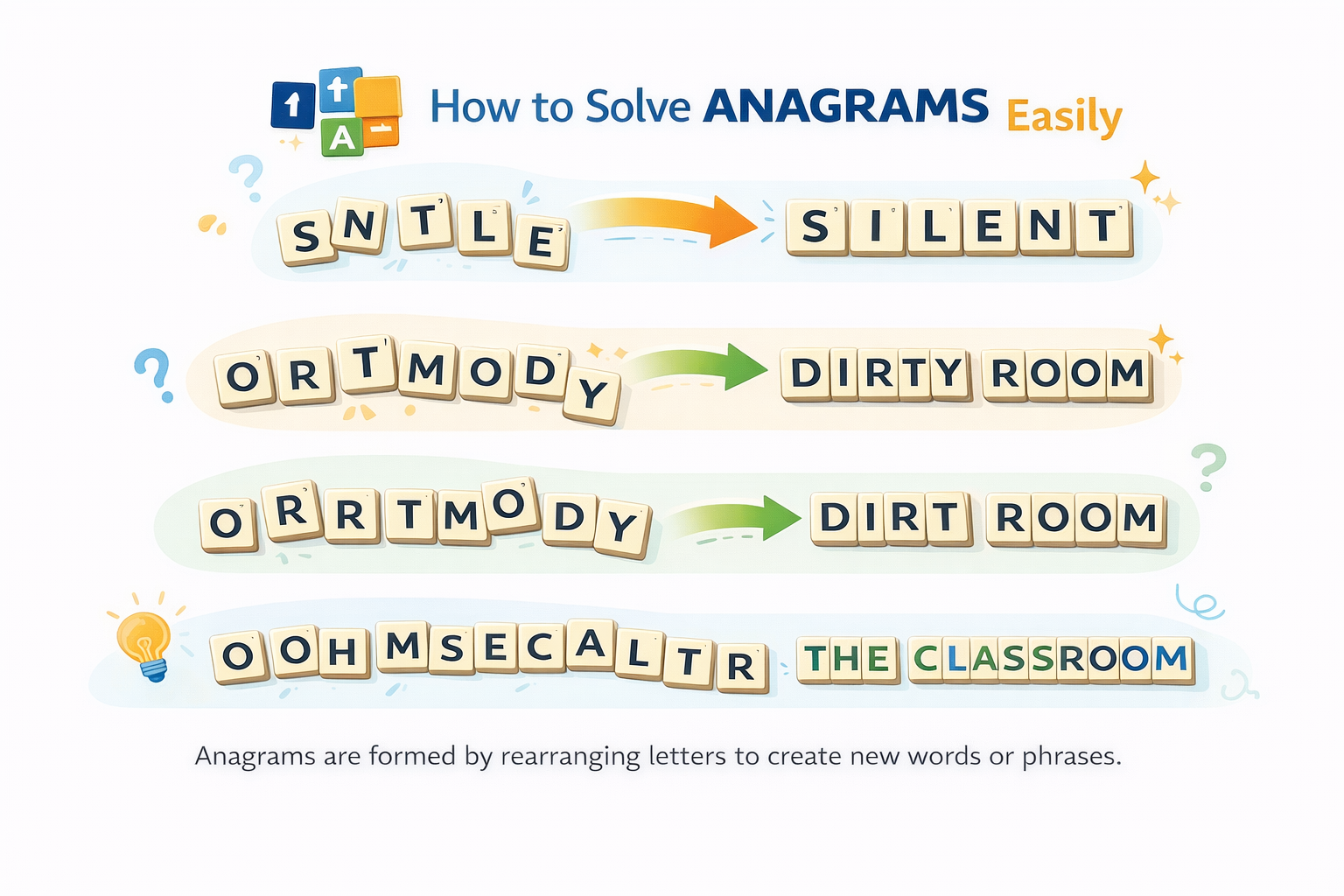
For example:
- Listen → Silent
- Dormitory → Dirty Room
- School Master → The Classroom
In each case, the letters remain exactly the same. Only the order changes.
Anagrams appear in many places:
- Word games such as Scrabble
- Crossword puzzles
- Brain training apps
- Literature and storytelling
A famous example appears in J.K. Rowling’s Harry Potter series, where the name Tom Marvolo Riddle rearranges into I Am Lord Voldemort.
This clever use of anagrams shows how powerful letter rearrangement can be in storytelling.
Why Solving Anagrams Is Good for Your Brain
Solving word puzzles does more than entertain you. It also strengthens several cognitive skills.
Research published by Harvard Health Publishing shows that word puzzles and brain games can help maintain cognitive function and improve mental agility.
When you solve anagrams, your brain practices:
- Pattern recognition
- Vocabulary recall
- Logical thinking
- Problem-solving
You also train your mind to identify letter combinations and word structures quickly. Over time, this skill improves your performance in word games and puzzles.
Step-by-Step Guide to Solve Anagrams
Let’s break down the process into practical steps that anyone can follow.
Step 1: Look at the Letters Carefully
Start by writing down the letters clearly. Many people miss obvious patterns because they rush through the puzzle.
For example:
Letters: R E A D
Possible words:
- Dear
- Read
- Dare
Take a moment to analyze the letters before attempting combinations.
A quick visual scan often reveals common word patterns.
Step 2: Identify Common Letter Patterns
English contains many common letter patterns. Recognizing them helps you solve anagrams quickly.
Examples include:
- TH
- CH
- SH
- ING
- ER
If a puzzle contains the letters T, H, and E, there is a high chance the word “the” appears somewhere in the result.
Professional puzzle solvers often train themselves to spot these patterns immediately.
Step 3: Break the Word Into Smaller Parts
Long words can feel overwhelming. Instead of solving the entire puzzle at once, break it into smaller pieces.
Example:
Letters: A S T R O N O M E R
Possible breakdown:
- star
- moon
- room
Eventually, these pieces lead to the famous anagram:
Astronomer → Moon Starer
Breaking large letter groups into smaller chunks makes the puzzle easier to handle.
Step 4: Rearrange Letters Physically
Sometimes the simplest solution works best.
Write the letters on paper or use tiles like those in Scrabble. Move them around physically. This approach helps your brain see new patterns.
Professional puzzle creators often recommend this method because visual movement triggers pattern recognition in the brain.
You can also sort letters alphabetically. This technique helps you track which letters remain unused.
Step 5: Start With Short Words
Short words often appear inside longer anagrams.
For example:
Letters: R E S T A U R A N T
Possible short words include:
- run
- sun
- eat
- star
Once you identify smaller words, the remaning letters become easier to organize.
Step 6: Learn Common Prefixes and Suffixes
Many English words contain predictable prefixes and suffixes.
Common prefixes:
- un
- re
- dis
- sub
Common suffixes:
- ing
- ed
- ness
- ment
Recognizing these patterns helps you identify word structures quickly.
For example:
Letters: R E A C T I O N
The suffix -tion appears frequently in English words.
This clue helps you form the word reaction faster.
Step 7: Use Online Tools for Faster Results
Even experienced puzzle solvers sometimes use digital tools to save time.
An anagram text generator can instantly rearrange letters and show possible word combinations. These tools analyze permutations of letters and compare them against large dictionary databases.
This method works especially well for:
- Long words
- Complex puzzles
- Competitive word games
If you get stuck on a difficult puzzle, a reliable anagram text generator can help you discover valid word combinations within seconds.
How Word Games Use Anagram Skills
Many popular word games rely heavily on anagram solving.
Examples include:
Scrabble
Players rearrange letter tiles to create high-scoring words on the board.
Success depends on recognizing patterns and forming words quickly.
Words With Friends
This digital game works similarly to Scrabble and rewards players who build longer words from limited letters.
Crossword Puzzles
Puzzle creators often hide answers using anagram clues.
For example:
Clue: “Listen rearranged becomes silence.”
Answer: Silent
These games demonstrate how practical anagram skills can be.
Common Mistakes When Solving Anagrams
Many beginners struggle with the same mistakes.
Here are the most common ones.
Ignoring letter frequency
Some letters appear more frequently in English words, such as E, T, A, O, and N.
Understanding this pattern helps you build words faster.
(Source: Oxford English Corpus frequency analysis)
Focusing on only one pattern
If one combination fails, try another arrangement instead of repeating the same attempt.
Flexibility helps you discover new solutions.
Forgetting small words
Short words like an, at, to, in, and on often appear inside larger puzzles.
Never ignore them.
Tips From Puzzle Experts
Experienced puzzle solvers recommend a few simple habits.
Practice regularly with word puzzles.
Read widely to expand your vocabulary.
Play word games like Scrabble and crossword puzzles.
Use digital tools to test difficult combinations.
Over time, these habits improve your speed and accuracy.
How Anagrams Help Improve Vocabulary
Anagrams also serve as powerful learning tools.
When you rearrange letters, you expose your brain to new word combinations. This process strengthens vocabulary retention.
Language teachers often use anagram exercises to help students:
- Learn new words
- Understand spelling patterns
- Recognize word structures
These exercises make language learning more interactive and engaging.
Final Thoughts
Anagrams prove that language can be playful, creative, and surprisingly logical at the same time. By simply rearranging letters, you can uncover hidden meanings and discover entirely new words.
Learning how to solve anagrams becomes easier once you understand patterns, prefixes, and letter combinations. With regular practice and the right strategies, anyone can improve their puzzle-solving skills.
And when a puzzle becomes too complex, using a reliable anagram text generator can quickly reveal valid word combinations and help you move forward.
In the end, anagrams remind us that sometimes a small shift in letters can unlock a completely new perspective.
What is the easiest way to solve anagrams?
The easiest way to solve anagrams is to rearrange letters step by step, look for common prefixes or suffixes, and identify smaller words inside the puzzle.
Are anagrams good for brain training?
Yes. Word puzzles such as anagrams help improve vocabulary, memory, and pattern recognition skills.
Can an anagram generator solve puzzles instantly?
Yes. An anagram generator analyzes letter permutations and compares them with a dictionary database to find valid words quickly.
What are some famous anagram examples?
Popular examples include:
Listen → Silent
Dormitory → Dirty Room
School Master → The Classroom