
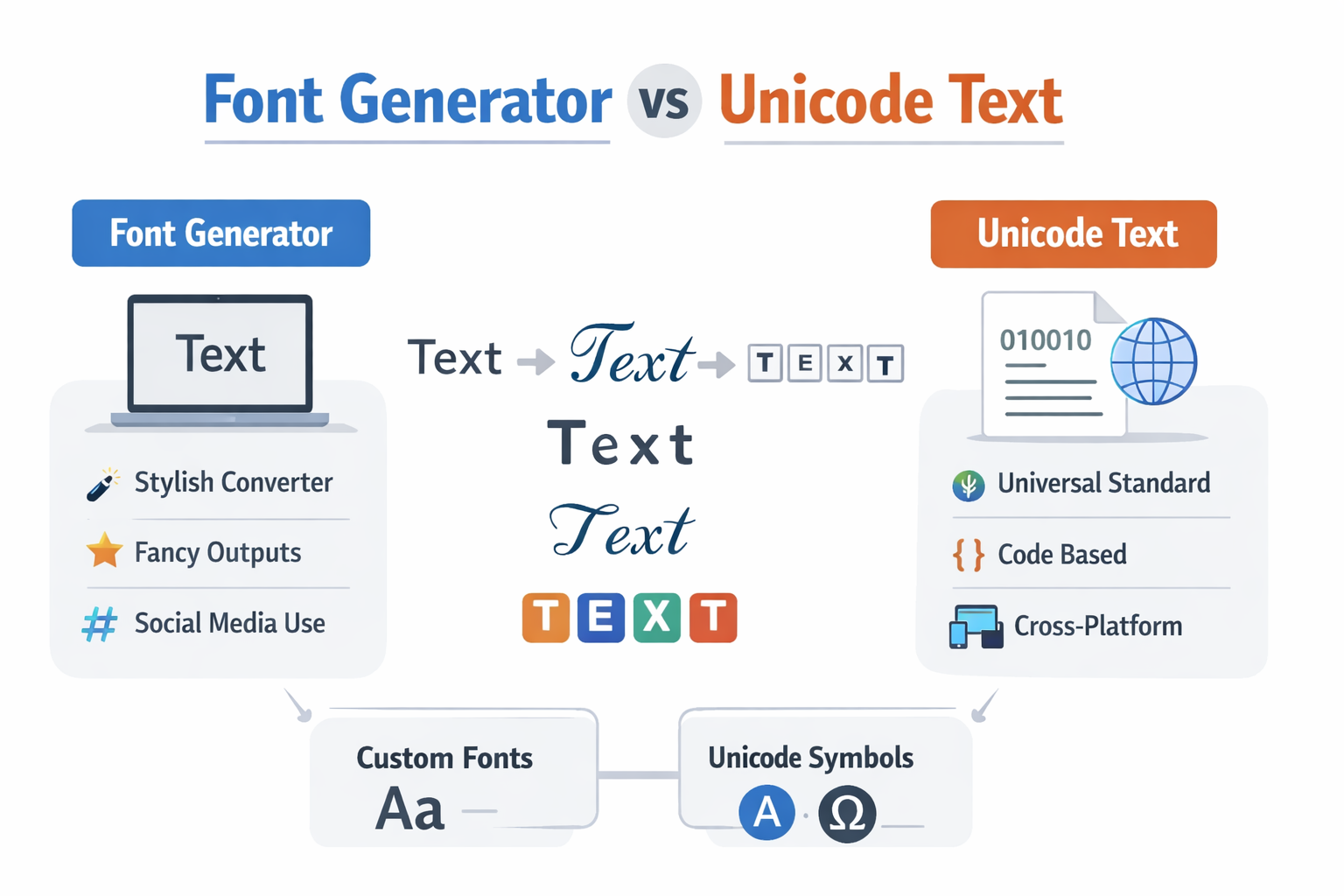
Text styling has become extremely popular on the internet. People use stylish text in social media bios, gaming usernames, captions, and even online branding. When someone wants decorative text, they usually search for a font generator or a Unicode text tool.
At first glance, both appear to do the same thing. They convert normal text into stylish versions. However, they work in very different ways.
Understanding the difference between font generators and Unicode text helps you choose the right tool, avoid compatibility issues, and create text that works everywhere online.
This guide explains how both technologies work, where they differ, and when you should use each option.
What Is a Font Generator?
A font generator is an online tool that transforms regular text into stylized text. Many websites provide font generators that create decorative text for Instagram bios, gaming usernames, and social media posts.
However, most online font generators do not actually create real fonts. Instead, they convert standard characters into Unicode symbols that resemble fonts.
For example, if you type:
Hello
A font generator may convert it into:
𝓗𝓮𝓵𝓵𝓸
Even though it looks like a new font, it is actually a sequence of Unicode characters that resemble decorative letters.
Why Font Generators Are Popular
Font generators gained popularity because they make text styling extremely easy. Users simply type their text, and the generator produces dozens of variations instantly.
People use them for many reasons:
- Creating stylish Instagram bios
- Designing unique usernames
- Making gaming nicknames
- Adding personality to social media captions
These tools work directly in the browser and do not require any software installation.
What Is Unicode Text?
Unicode text refers to characters defined by the Unicode Standard, a global system that assigns a unique number to every character used in digital text.
The Unicode Consortium maintains this standard to ensure that text appears consistently across devices, software, and operating systems.
According to the official Unicode Standard documentation, the system supports over 149,000 characters across 161 scripts. These include letters, numbers, symbols, emojis, and special mathematical characters.
Unicode allows computers to display characters from languages such as English, Chinese, Arabic, and Hindi in a consistent way.
Why Unicode Exists
Before Unicode, computers used many different character encoding systems. Text created on one system often appeared broken on another.
Unicode solved this problem by creating a universal encoding standard that works across platforms.
Today, Unicode powers nearly all modern digital text, including:
- Websites
- Mobile apps
- Operating systems
- Programming languages
- Messaging platforms
Without Unicode, the modern internet would struggle to display multilingual text correctly.
How Font Generators Use Unicode
Most online font generators rely heavily on Unicode characters.
They take a word like:
Text
Then replace each letter with a visually similar Unicode symbol.
Example:
Normal text
Text
Stylized Unicode text
𝕋𝕖𝕩𝕥
In this case, the generator does not create a new font file. Instead, it selects existing Unicode characters that look decorative.
This technique allows the styled text to remain copy-paste friendly, which is why it works on social media platforms.
Key Differences Between Font Generators and Unicode Text
Although they are closely related, these two concepts serve different purposes.
1. Technology
Unicode text represents a standardized character encoding system.
Font generators act as tools that convert regular characters into Unicode symbols that resemble fonts.
Unicode is the underlying system. Font generators are applications built on top of it.
2. Function
Unicode exists to support global text compatibility across devices and languages.
Font generators exist to create decorative or stylized text quickly.
Unicode focuses on technical consistency. Font generators focus on creativity and design.
3. Usage
Unicode appears everywhere in modern computing.
It powers:
- Web pages
- Programming languages
- Mobile operating systems
- Messaging platforms
Font generators usually appear on websites that help users create stylish text for social media or gaming profiles.
4. Output
Unicode provides the characters themselves.
Font generators provide visual transformations of text using those characters.
This difference often causes confusion because the results look like real fonts.
Quick Comparison
| Feature | Unicode Text | Font Generators |
|---|---|---|
| Purpose | Standard character encoding | Stylish text creation |
| Maintained by | Unicode Consortium | Independent tools |
| Used in | All modern software | Online styling tools |
| Creates real fonts | No | No |
| Uses Unicode symbols | Yes | Yes |
Why Stylish Text Works on Social Media
Many people wonder why text from font generators works in social media bios and usernames.
The reason lies in Unicode compatibility.
Since most social media platforms support Unicode characters, the decorative symbols produced by font generators remain readable.
Platforms that support Unicode include:
- Twitter (X)
- Discord
However, not every platform supports every Unicode character. Some symbols may appear differently depending on the operating system or font installed on the device.
Limitations of Unicode-Based Font Generators
Although font generators offer convenience, they also have limitations.
Compatibility Issues
Some Unicode characters do not display correctly on older devices or software. This problem occurs when the system lacks the required font support.
Search Engine Limitations
Search engines primarily understand standard characters. Decorative Unicode text may reduce readability or indexing if overused.
Accessibility Concerns
Screen readers may struggle to interpret unusual Unicode characters. This issue can affect accessibility for visually impaired users.
For these reasons, it is best to use stylized text sparingly in important content such as articles or headings.
When Should You Use a Font Generator?
Font generators work best in creative or informal environments.
Good use cases include:
- Social media bios
- Gaming usernames
- Chat messages
- Online communities
- Personal branding
They help users create unique text quickly without installing fonts or design software.
However, they should not replace normal text in professional writing, academic documents, or SEO-focused content.
When Should You Use Unicode Text Directly?
Unicode text appears naturally whenever you type on a modern device. Most users never interact with it directly because software handles the encoding automatically.
However, developers and designers may use Unicode intentionally in situations such as:
- Mathematical notation
- Special symbols
- Multilingual content
- Emoji integration
In programming and web development, Unicode ensures that text renders correctly across different environments.
Real Example of Unicode in Action
Consider the word Cafe.
Without Unicode, the accented version Café might break on systems that lack the correct encoding.
Unicode assigns a unique code point to the character é, ensuring that it appears correctly across devices.
This consistency forms the backbone of international communication on the internet.
Why Unicode Matters for the Modern Internet
Unicode remains one of the most important standards in computing.
Organizations such as the World Wide Web Consortium (W3C) support Unicode because it ensures consistent text rendering across the web.
Without Unicode, global websites would struggle to display multilingual content reliably.
This universal standard allows billions of users to communicate online in their native languages.
How Text Styling Will Evolve
As digital communication grows, text styling tools will continue to evolve.
Modern tools now combine:
- Unicode symbols
- Emoji characters
- Typography effects
- Text formatting
However, the foundation will remain the same. Unicode will continue to serve as the universal system for digital text representation.
Font generators will simply provide creative ways to use that system.
Conclusion
Understanding the difference between font generators and Unicode text helps users avoid confusion and use text tools more effectively.
Unicode forms the backbone of modern digital communication. It assigns unique identifiers to characters and ensures consistent display across platforms.
Font generators, on the other hand, act as creative tools that transform standard text into decorative versions using Unicode characters.
Both play important roles in the online world. Unicode powers the infrastructure of global communication, while font generators add creativity and personalization to digital text.
When used correctly, they allow users to combine technical reliability with visual expression, making text both functional and fun.
Frequently Asked Questions
What is the difference between a font generator and Unicode text?
The main difference is that Unicode text is a global character encoding standard, while a font generator is a tool that converts normal text into stylized Unicode characters. Unicode ensures consistent text display across devices, whereas font generators focus on creating decorative text styles for social media, usernames, and creative content.
Are font generators actually real fonts?
No, most online font generators do not create real font files. They simply replace standard letters with Unicode symbols that visually look like different fonts. This allows the text to remain copy-paste friendly across many platforms.
Why do font generators work on social media?
Font generators work on social media because most platforms support Unicode characters. When a generator converts text into Unicode symbols, those characters remain readable on platforms like Instagram, Twitter (X), Facebook, and Discord.
Is Unicode text safe to use online?
Yes, Unicode text is completely safe to use. It is the official standard for digital text encoding and is supported by modern operating systems, websites, and applications worldwide.
Can Unicode characters affect SEO?
Yes, excessive use of decorative Unicode characters can affect readability and search engine understanding. Search engines prefer standard readable text, so it is best to use stylized Unicode text mainly for social media or creative content rather than important website headings.