
Word puzzles have entertained people for centuries. They challenge the brain, expand vocabulary, and add a playful twist to language. Among the most popular types of word puzzles are anagrams, word scrambles, and jumbles. At first glance, these puzzles may look similar because they all involve rearranging letters. However, each one follows slightly different rules and serves different purposes.
If you enjoy word games such as Scrabble, crossword puzzles, or mobile word apps, you have likely encountered these puzzles before. Understanding their differences helps you solve them faster and enjoy them more.
In this guide, we will explore the difference between anagrams, word scrambles, and jumbles, how each puzzle works, and when to use the right strategy to solve them.
What Is an Anagram?
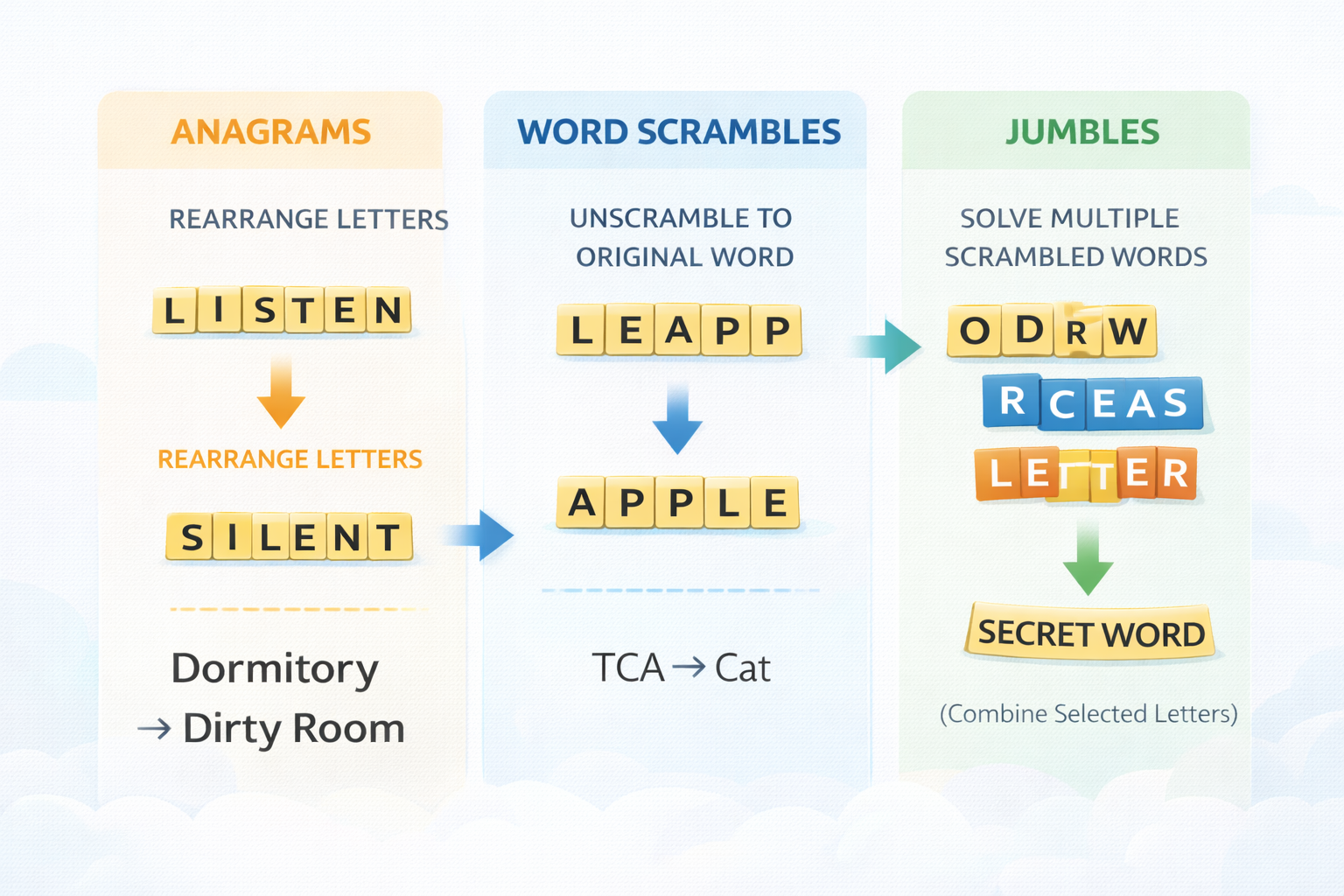
An anagram forms when the letters of a word or phrase rearrange to create a completely new word or phrase using the exact same letters.
The key rule is simple:
No letters get added or removed. The puzzle only changes their order.
For example:
- Listen → Silent
- Dormitory → Dirty Room
- School Master → The Classroom
These examples show how rearranging letters can produce a surprising new meaning.
Anagrams have a long history in literature and language play. Writers, poets, and scholars have used them for centuries. Even historical figures enjoyed them. For instance, the name “William Shakespeare” has appeared in playful anagram forms such as “I am a weakish speller.”
In modern times, anagrams appear in:
- Word games like Scrabble
- Crossword puzzles
- Brain-training apps
- Creative writing exercises
Many players also use digital tools such as an anagram text generator to quickly discover valid combinations of letters.
What Is a Word Scramble?
A word scramble works differently. Instead of hiding a new phrase inside another word, it simply mixes up the letters of a single word. The goal is to rearrange those letters and find the original word.
For example:
- TCA → Cat
- ODG → Dog
- PALEP → Apple
In word scrambles, the puzzle usually has only one correct answer. The letters appear in random order, and the player must identify the correct word.
Word scrambles often appear in:
- Educational worksheets
- Vocabulary games
- Children’s learning activities
- Mobile puzzle apps
Teachers frequently use them to help students practice spelling and vocabulary. Because the puzzle focuses on one correct word, it works well for learning environments.
According to educational resources from Merriam-Webster and Oxford Dictionaries, word puzzles like scrambles improve vocabulary recognition and cognitive flexibility.
What Is a Jumble Puzzle?
A jumble puzzle is a special type of word scramble that adds an extra challenge.
In a typical jumble puzzle:
- Several scrambled words appear first.
- The player must solve each scrambled word.
- Certain letters from those answers then combine to form a final mystery word or phrase.
For example:
Scrambled words:
- ODRW → WORD
- RCEAS → SCARE
- TLETR → LETTER
After solving them, selected letters combine to reveal the final answer.
Jumble puzzles have appeared in newspapers for decades. One of the most famous examples is the Jumble puzzle column created by Martin Naydel and later developed by Tribune Media Services.
Today, you can still find daily jumble puzzles in newspapers and puzzle books worldwide.
Key Differences Between Anagrams, Word Scrambles, and Jumbles
Although these puzzles look similar, they serve different purposes.
| Puzzle Type | Main Goal | Key Rule |
|---|---|---|
| Anagram | Create a new word or phrase using the same letters | Letters must stay the same |
| Word Scramble | Find the original word from mixed letters | Usually one correct answer |
| Jumble | Solve several scrambled words and reveal a final answer | Multi-step puzzle |
The main difference lies in how the letters transform.
Anagrams create new meanings from existing letters.
Word scrambles restore the original word.
Jumbles combine multiple solved words into a final puzzle.
Why These Word Puzzles Are Good for Your Brain
Word puzzles do more than entertain. They also improve cognitive skills.
Research from Harvard Health Publishing shows that puzzles stimulate several brain functions, including memory, problem-solving, and language processing.
When you solve puzzles like anagrams or scrambles, your brain performs several tasks:
- Recognizing letter patterns
- Testing possible combinations
- Recalling vocabulary
- Evaluating correct word structures
These activities strengthen neural connections and improve mental agility.
Word games also encourage creative thinking. When you rearrange letters, you begin to notice patterns you might normally overlook.
This ability to see hidden structures in language often improves writing, reading comprehension, and spelling.
Strategies to Solve Anagrams
Anagrams can look difficult at first. However, several simple techniques make them easier.
First, look for common prefixes and suffixes. Words often contain familiar patterns such as:
- re
- un
- dis
- ing
- ed
- ly
Identifying these parts can quickly reveal the structure of a hidden word.
Second, search for short words inside the letters. If you can spot smaller words, you can often build larger phrases around them.
Third, rearrange vowels and consonants separately. Many English words follow predictable patterns where vowels appear between consonants.
Finally, if you want faster results, you can use an anagram text generator to test multiple letter combinations instantly.
Tips for Solving Word Scrambles
Word scrambles require a slightly different approach.
Start by identifying familiar letter combinations such as:
- TH
- CH
- SH
- ING
These patterns appear frequently in English words.
Next, try reading the letters aloud. Sometimes hearing the sound helps your brain recognize the correct word.
You can also sort the letters alphabetically. This small trick sometimes reveals patterns you may not notice otherwise.
Most importantly, stay patient. Scrambled words often look confusing at first, but once you spot the correct structure, the answer becomes obvious.
How Word Games Improve Vocabulary
Word puzzles play an important role in language learning.
According to the Oxford English Dictionary language studies, regular exposure to word puzzles improves vocabulary retention and word recognition.
When players solve puzzles, they repeatedly encounter new words. This repetition strengthens memory and improves language understanding.
Word games also expose players to unusual letter combinations and rare words. Over time, this expands vocabulary naturally.
Students, writers, and language learners often use puzzles as a fun way to practice spelling and word formation.
Digital Tools for Solving Word Puzzles
Technology has made word puzzles easier to explore.
Online tools can generate possible word combinations instantly. These tools analyze letter permutations and compare them with large dictionary databases.
For example, a modern anagram text generator can quickly reveal dozens of possible word combinations from a single set of letters.
These tools do not replace learning. Instead, they help users understand patterns and discover new vocabulary.
Many professional Scrabble players also use such tools during practice sessions to study word combinations and improve strategy.
Which Puzzle Is the Most Challenging?
Each puzzle type offers a different level of difficulty.
Anagrams often challenge creativity because they can produce multiple valid answers. Players must explore many combinations before finding meaningful words.
Word scrambles are usually easier because the puzzle typically has one correct solution.
Jumble puzzles add complexity by combining several solved words into one final answer.
Because of this multi-step process, jumbles often require the most patience and attention.
However, many players enjoy this extra challenge because it feels more rewarding when the final solution appears.
Final Thoughts
Anagrams, word scrambles, and jumbles all belong to the same family of word puzzles. Each one challenges the brain in a different way.
Anagrams transform letters into new meanings.
Word scrambles restore the correct word.
Jumbles combine several solutions into a final mystery phrase.
Together, these puzzles offer a fun and effective way to improve vocabulary, strengthen memory, and sharpen problem-solving skills.
Whether you solve them for fun, learning, or competition, word puzzles reveal how flexible and creative language can be.
And sometimes, all it takes is a simple rearrangement of letters to discover something completely new.
Frequently Asked Questions
What is the difference between an anagram and a word scramble?
An anagram rearranges letters to create a new word or phrase using the same letters. A word scramble simply mixes the letters of a word and asks the player to find the original word.
Are jumbles the same as word scrambles?
Jumbles are a type of word scramble, but they usually include multiple scrambled words that combine to form a final answer.
Why are anagrams popular in word games?
Anagrams challenge players to recognize letter patterns and build new words, making them popular in games like Scrabble and crossword puzzles.