
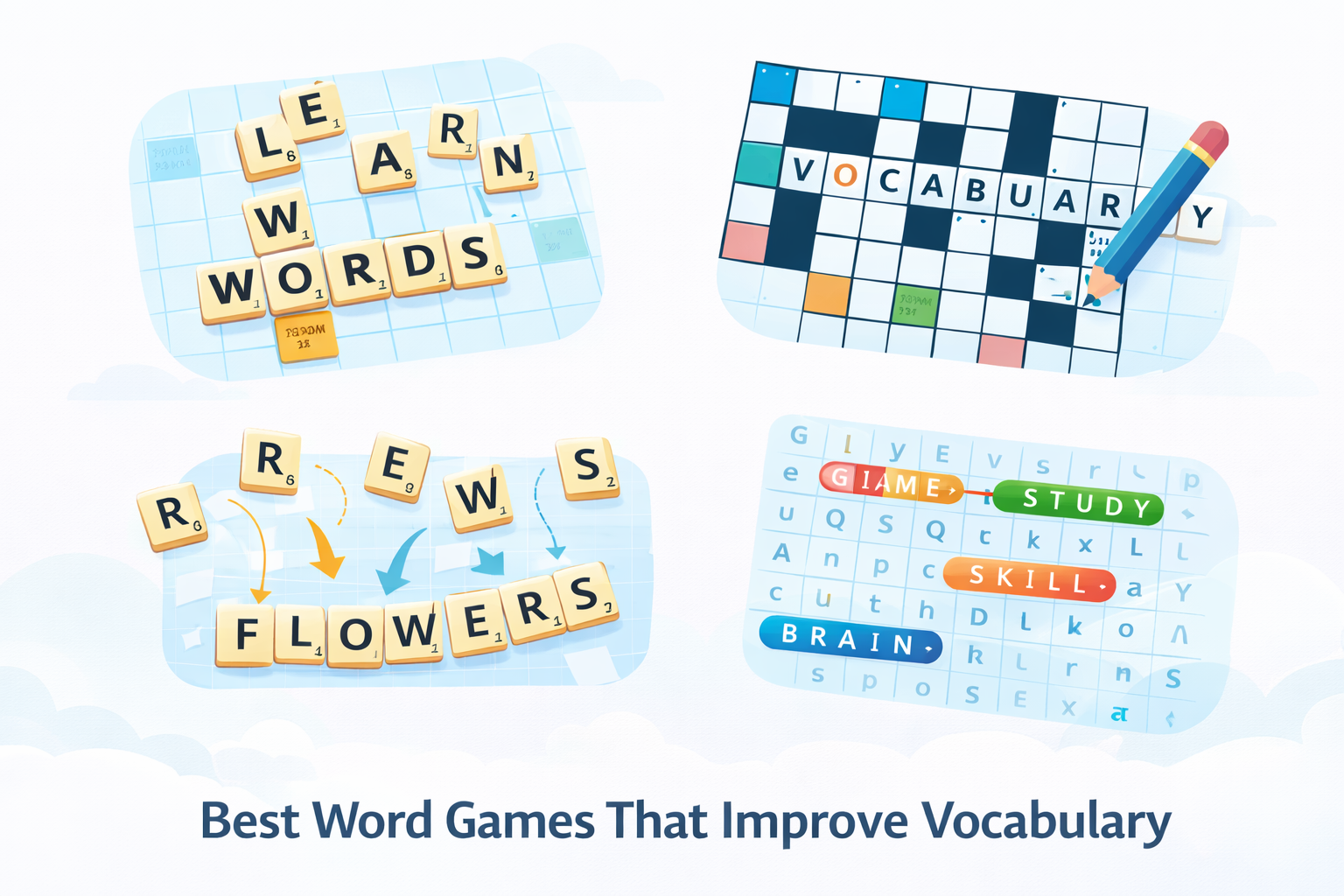
Language grows stronger with practice. One of the easiest and most enjoyable ways to build vocabulary is through word games. These games train your brain to recognize patterns, discover new words, and think creatively with language.
Unlike traditional memorization methods, word games make learning natural. They combine logic, memory, and problem-solving while keeping the process entertaining. That is why teachers, linguists, and cognitive researchers often recommend word games as a practical learning tool.
In this guide, we explore some of the best word games that improve vocabulary, explain how they work, and show how they help you learn new words faster.
Why Word Games Help Improve Vocabulary
Word games work because they actively engage the brain. Instead of reading or memorizing words passively, you interact with language in a playful environment.
Research from Harvard Health Publishing suggests that puzzles and word games stimulate multiple areas of the brain responsible for memory and language processing. When you solve word puzzles, your brain forms stronger connections between words and meanings.
Word games also:
- Encourage active learning
- Improve spelling and word recognition
- Strengthen memory and recall
- Develop pattern recognition skills
In short, they transform vocabulary building from a boring task into an enjoyable challenge.
Scrabble: The Classic Vocabulary Builder
Scrabble remains one of the most famous word games in the world. Since its creation in the 1930s, millions of players have used it to test their vocabulary skills.
In Scrabble, players build words using letter tiles on a game board. Each letter has a point value, and the goal is to create the highest-scoring word possible.
The game improves vocabulary because it encourages players to:
- Discover unfamiliar words
- Experiment with letter combinations
- Learn strategic word placement
Serious Scrabble players often develop large personal word lists and study dictionaries to improve their performance.
According to the Merriam-Webster dictionary, many players use Scrabble as a tool to explore new words and understand how language evolves.
Crossword Puzzles
Crossword puzzles challenge your ability to recall words from clues. Each clue requires you to connect definitions, synonyms, or word associations to fill the puzzle grid.
This process strengthens both memory and vocabulary knowledge.
Crosswords help because they:
- Encourage deep word recall
- Introduce uncommon vocabulary
- Improve general knowledge
Many newspapers publish daily crossword puzzles because they provide mental exercise while expanding language skills.
The New York Times crossword, for example, has become famous for pushing players to learn new words and cultural references.
Word Search Games
Word search puzzles focus on recognition rather than creation. Players scan a grid of letters and locate hidden words placed horizontally, vertically, or diagonally.
Although simple, word searches help learners:
- Recognize word patterns
- Improve spelling awareness
- Strengthen visual scanning skills
Teachers frequently use word searches in classrooms because they help students become familiar with new vocabulary without overwhelming them.
They also make vocabulary practice accessible for beginners.
Anagram Games
Anagrams involve rearranging the letters of a word to form new words or phrases. For example:
Listen → Silent
Dormitory → Dirty room
These puzzles strengthen language awareness because they force players to examine letter combinations carefully.
Anagram games improve vocabulary by:
- Encouraging flexible thinking
- Revealing hidden word structures
- Teaching letter pattern recognition
Many players now use digital tools such as an anagram text generator to experiment with different letter combinations and discover new words quickly.
These tools allow learners to explore word patterns in seconds, which makes anagram practice much more effective.
Word Association Games
Word association games build vocabulary through connections. A player hears or sees a word and must quickly respond with a related word.
For example:
Ocean → Water
Water → River
River → Bridge
This simple exercise strengthens vocabulary networks inside the brain.
Language researchers often explain that vocabulary works like a web. When you connect words through association, you improve recall and comprehension.
Word association games help learners think faster and expand their vocabulary naturally.
Boggle: Fast Thinking with Words
Boggle is a fast-paced word game where players find as many words as possible from a grid of random letters.
Players usually have three minutes to discover words hidden within the grid.
This time pressure improves vocabulary because it encourages quick thinking and pattern recognition.
Boggle strengthens:
- Word recognition speed
- Spelling skills
- Mental flexibility
Teachers often use Boggle in classrooms because it encourages students to experiment with language without fear of mistakes.
Digital Word Games and Apps
Technology has introduced a new generation of word games. Mobile apps and online platforms now offer interactive puzzles that help users improve vocabulary anywhere.
Popular digital word games include:
- Wordscapes
- Words With Friends
- Word Connect
These games combine traditional vocabulary exercises with engaging gameplay.
Many digital platforms also include learning tools that show word meanings, synonyms, and definitions after each puzzle.
This instant feedback helps players understand the words they discover.
How Word Games Improve Memory and Language Skills
Word games train several important cognitive abilities.
First, they strengthen memory recall. When you search for words in puzzles, your brain retrieves vocabulary stored in long-term memory.
Second, they improve pattern recognition. Language often follows predictable patterns, and word games teach players to recognize them quickly.
Third, they enhance problem-solving skills. Each puzzle requires logical thinking and experimentation.
Studies published by the American Psychological Association (APA) suggest that word puzzles help maintain cognitive flexibility and mental agility.
These benefits make word games valuable not only for students but also for adults who want to keep their minds sharp.
Tips to Learn Vocabulary Faster with Word Games
Playing word games becomes more effective when you follow a few simple strategies.
Focus on New Words
When you encounter an unfamiliar word, write it down and check its meaning in a reliable dictionary.
Practice Regularly
Short daily practice sessions often produce better results than long occasional sessions.
Combine Multiple Games
Each word game develops different skills. Combining crossword puzzles, anagrams, and word searches creates balanced vocabulary training.
Use Digital Tools
Tools such as an anagram text generator can help you experiment with word structures and discover hidden combinations you might miss manually.
The Educational Value of Word Games
Word games play an important role in modern education. Teachers use them to introduce vocabulary without making lessons feel heavy or technical.
Students often learn faster when they interact with language through puzzles instead of memorization.
Word games also support independent learning. Anyone can practice them at home, on a phone, or during travel.
This accessibility makes them one of the most practical vocabulary-building tools available today.
Final Thoughts
Word games prove that language learning does not need to feel like homework. By combining curiosity, logic, and creativity, these games turn vocabulary practice into an engaging activity.
From classic board games like Scrabble to digital puzzles and anagram challenges, every format strengthens language skills in a different way.
When you play regularly, you begin to notice new words, patterns, and connections in everyday language.
So the next time you want to improve your vocabulary, skip the boring memorization list. Pick up a puzzle, shuffle some letters, and let word games train your brain while you enjoy the process.